

When Scars Count Us In
and the most important letter I ever wrote


The year was 2010.
The baby was six months old, and I was the new student in the classroom.
The official name of the course was Freelance Writing Workshop. I’d secretly wanted to register for the memoir class also listed in the catalog, but thirty-two-year-old me couldn’t quite let myself sign up for that one.
Memoir was the goal—it has always been the goal—but that word felt too big for me back then. Too self-absorbed, too grandiose for little, unpolished me—a new wife, a new mother. These were supporting roles, not leading ones.
Besides, I already carried enough guilt.
Leaving the house—even for a haircut or a cycling class or a quick Target run—required planning, pumping, permission, and an internal wrestling match.
So three hours away from home every Wednesday morning just to write? That bordered on indulgent. I tended to only mention my new class to select people on braver days, usually with the qualifying words “just for fun” or “hobby” peppered in. I might throw in the fact that it cost $83, so they’d know I wasn’t serious or even good, especially if I’d slipped and mentioned the word “memoir.”
But soon enough, I understood that memoir is precisely what we were doing inside that classroom, week after week.
We sat in a circle of rectangular tables pushed together, swapping stories, preserving memories, and making meaning out of our lives. We bore witness to one another’s wounds, wonderment, and wisdom.
Sure, along the way, we learned about em dashes and show-not-tell and narrative arc, but the core of what we were doing was connecting as humans. Writing was simply our chosen medium.
Among our circle sat widows and bereaved parents. There were first-generation immigrants and decorated military veterans and long-retired teachers. People who had lived through wars and losses and illnesses I couldn’t yet imagine. Most of them had two, three, even four decades on me.
Despite the casual vibe and warm reception, it took weeks for me to quit feeling like an outsider. I was an amateur writer, and my relative youth felt like a disadvantage in this group. I didn’t yet know how not to compare stories and scars, and I fretted over every adverb and tense and instance of passive voice.
I wanted to impress, I wanted to belong, and I wanted a way in.
It was my scar that proved my way in.
And not just the thin, still-raised raspberry scar stretching between my pelvic bones—the result of an emergency C-section during my son’s traumatic entry into this world. No, that particular scar, like my son, became a source of pride and purpose. Both of us could have died that day, but instead, it marked a new beginning for us both. It did not matter that this child was no longer in my belly. Like the scar, I would carry both with me for the rest of my days.
But it was my other scar that had led me to this creative writing class—the invisible scar I now bore as the wife of a paraplegic. Chris had survived the motorcycle crash five weeks before our son arrived, but it had left him paralyzed.
Life since then had been a nonstop tilt-a-whirl, yet somehow, filling a blank page over and over again slowed the spinning.
Some scars in that class were visible, but most were not. Each one counted us in.
We gathered every Wednesday morning, nine until noon at the local community center—a bunch of mismatched socks thrown together in our various degrees of frayed and faded that somehow all belonged, all mattered.
We folded ourselves into rigid plastic chairs that scraped across dingy linoleum floors. Dust bunnies hung out in the corners, and the whole building looked as though it had simply given up. Depending on the season, the rooms were either runny-nose freezing or sweaty-pits hot, but the one constant was the musty scent of books, chalk, and time.
But no matter the season, I ran hot in that class. No breathing techniques, cold water bottles, or seating choices could prevent my face from flushing crimson when it came my turn to share.
The redness made sense—a woman learning to write, to heal, and to open up to a group of strangers all at once?
Sometimes the responses were encouraging, and sometimes I wanted the floor to open up and swallow me whole.
My hardcopy for the instructor usually came back marked up in green—her preferred ink color for comments and critiques.
I’d liked Sylvia from the start and longed for her approval, which only inflamed my cheeks more whenever it was my turn in the hot seat.
I grew convinced that Sylvia was harder on me than most other students, and I’d taken it personally without seeing the honor this also carried.
But back then, my writerly skin simply wasn’t thick enough, and my stupid trembling hands gave me away as much as my cheeks. I loathed the way my own body betrayed me—a nervous dog with its tail curled between its own legs.
Still, every Wednesday I showed up. I completed all the assignments, and I never passed when it came my turn to share.
Ironically, the building that housed so many of my pivotal moments only exists in memory now. In its place today stands a modern structure of glass and wood. Drought-resistant landscaping and air-conditioned rooms and shiny-tiled bathrooms with automatic faucets and flushers. Sure, the new building is attractive, but my heart aches for the older building that had come to feel like a trusted friend.
Looking back now, I realize what I couldn’t possibly have understood then.
Writing saved me—and I don’t mean once, nor do I mean every Wednesday in that classroom.
Writing saved me in the grander, big-picture way. Because even on the days that my hands were too busy and cracked and calloused to pick up a pen, I was still beginning to live as a writer.
Despite tremendous external uncertainty, my internal world continued to flourish with gratitude, hope, and presence. I found my own creative nook to bend time long enough to notice, feel, and process. The blank page provided a place to connect the dots and make meaning amidst every unanswerable why.
Writing has a way of making beautiful and meaningful art, even on the ugliest of canvases. Even if it’s never meant to be hung for public consumption.

I remained in that writing workshop for a few years—through a second pregnancy, and through an entire eighty-thousand-word manuscript. One afternoon, I’d eventually sit with Sylvia in her sunny backyard, talking over lemonade as her cats wandered about her garden of weeds and wildflowers. She’d handed me back my edited manuscript, filled with slashes and circles and words of support. I didn’t dare peek at the papers in my hand until I’d returned to my car and driven a block away. But to this day, I will always associate the color green with kindness. And smile when I think of that hour we spent together in the sun. Two writers.
Only my education was just beginning. Back then, I’d still believed I was writing my husband’s journey. It was a story centered around his paralysis, his grief, and his grit. Naturally, my son and I were a big part of the story, but I was the narrator solely because I held the pen, not a plot all my own.
The irony, of course, is that while carefully capturing all the wreckage and recovery of my husband’s experience, I was unintentionally tending to my own.
The Letter
One week, our homework was to write a short story from the perspective of an inanimate object.
I can’t recall when I decided to write a letter from my husband’s wheelchair.
Maybe it was the moment Sylvia doled out the assignment. Maybe it was on the drive home. Or maybe it was while walking up the newly constructed ramp to our front door, and I longed for several versions of me—one to scoop up my sweet-smelling baby, one to go lie down beside my weary husband, and another to go sit uninterrupted at my desk to write and write and write. Every part of me ached in those moments, as though continually torn between desires and duties and demands. All these words and years and babies later, I have yet to figure out how to hold onto everything in a moment without fear that something irreplaceable is slipping through my fingers.
But I do remember exactly when and where I wrote the assignment: a small table, a crowded Starbucks, a green tea matcha latte beside me.
I wrote the entire piece in one sitting with pen and paper. My words flowed, and my hand ached as I struggled to keep up. And I’d cried, too, right there in the middle of the coffee shop. Blowing my nose and everything.
Not because I was sad but because I knew my words on that lined paper were good and true and all mine.
Dear Friend,
We met only recently, and yet I know you well.
I feel the way your body stiffens when people stop and stare. I sense the unease in your gut when unsolicited hands
reach out to help. I notice the stoop in your shoulders when a stranger presumes they must speak to you loud and slow. I know the way your breath catches when a dog announces our approach.
I hear the sigh that escapes your lips when you spot our reflection in a windowpane. I feel the rhythmic longing in your feet as your wife and child twirl about the room. I detect the lingering sadness in your heart from having sold your dirt bikes. I sympathize with your internal struggle—gratitude for all that you have, mourning for all that you have lost.
I too will never forget the day we were alone and tumbled in the crosswalk...the chips in my paint, the bruises on your ego. Without delay, you pulled us back up amidst the gawkers. I shuddered along with you at the uncertainty of a broken bone you could no longer feel.
Sometimes I know you appreciate me. I give you freedom to head outside when the sun calls your name. I make it possible for you to go to work each day, and I don’t mind how thankful you are that I all but disappear behind your desk. I come most alive when you pop a wheelie or throw your hands in the sky as we coast downhill, for it is in these moments I know I’ve earned your trust.
I recall the day you gave me a real name. You and your wife took turns sharing, alternating between smiles and sniffles. When your words ran out, you put down the tissue and reached for each other’s hand. It was your therapist who suggested you two give me a name. It didn’t hurt my feelings that you wanted to disassociate yourself from me—I know I am often a burden. I’m hard to navigate in cramped quarters and am no fun in the rain. I make parking a challenge, and I take up all the room in your trunk. I hurt your wife’s back, and I muddy her jeans. Sometimes I embarrass you. So I welcomed my new name and any other way I could lighten the load from your weary shoulders.
I too love your son. My favorite part of the day is when he climbs into your lap and we whip around the room, his giggles that transform into hiccups as you murmur in his ear...”Vrooom!” My adoration for your son has only grown with his size. While many are intimidated by me, he gazes at me with wonder. He crawls to me from across the room to investigate my spokes with curious fingers and slap my frame with pudgy hands. My spirit soared the day he held onto me with both hands and stood upright for the first time.
I have come to feel like part of the family, but have no fear—your wife only has eyes for you. To her, I am invisible. Whenever we enter the room, it is only you she sees. I know there was another before me. His presence in the shed reminds me that I am replaceable. There are others out there...newer, younger and lighter than myself. The nicks on the wood furniture and scuffmarks along the walls are lasting souvenirs from our first rocky days, our dirty laundry left out for the world to see.
I am honored to take my place beside you each night, watching over you from my bedside post, motionless while your mind roams free. It is during these hours that our dreams align most. Only you can bring me to life, and yet I too pray for the day we can say goodbye.
Until then, I will go on silently knowing you and serving you the best that I can.
Yours truly, Clyde
Every writer knows that feeling. For me, it is rare and fleeting, yet it’s also a possibility that keeps me trying. Every time I sit at my desk to write, I’m back at the slot machine of creativity, pulling the lever again and again, hoping to land once more on that ever-elusive jackpot. Writing is not unlike gambling: there is payoff, but it comes at a cost. Writing is both an act of discipline and an act of faith: I am both paying my dues and praying for my muse.
I named my essay Letter from Clyde. (“Clyde” being the random name my hubby had given his wheelchair.) Pen in hand, I tried to imagine all that only Clyde could witness: the long days and lonely hours. The quiet victories and loud defeats. The swallowed screams and the invisible tears. And yes, the love. So much love.
When Wednesday rolled around, I couldn’t wait to share. The response from my fellow classmates was sweet, but it was Sylvia’s reaction that made me soar. She’d held her head cocked to one side, eyeing me and choosing her words carefully. Her trademark green pen was poised and unmoving above the printed copy I’d handed her to read along.
As usual, my cheeks caught fire. I flushed from praise as much as I did from criticism, yet I didn’t look away this time. I was learning to be seen. I wanted to be seen.
Encouraged, I shared Letter from Clyde in a bigger way—on my blog and with friends and family.
And it was then that my words took on a life of their own.
My cousin Nina, a fifth-grade teacher at a local public school, asked if she could use it as part of her class curriculum. Not just her own students, either, but all fifth-grade classes.
Students were assigned the same prompt: write from the perspective of an inanimate object, be it a clock, a locker, or a backpack. Whatever they desired. Students would read Letter from Clyde first, then write their own essay.
To them, it was simply a creative writing assignment meant to reflect on their time at elementary school before heading off to the bigger sea of middle school. It was intended as an exercise on perspective.
To me, it became proof that words could connect, save, and offer language even when words seem to fail.
A writer never really knows if their words will endure or be buried by the sands of time. I had no clue that short essay of mine—first introduced as curriculum over fifteen years ago—would continue to be used by teachers every spring, inviting students to discover different points of view.
Nina, now retired, returned to her former school one day last spring as a substitute teacher. She sent me a text, letting me know that Letter from Clyde was still being used.
Tears blurred my vision as I read her message, did the math, and felt the significance.
One hundred and twenty students a year, all these years later?
Those initial fifth graders would now be in their late twenties—grown adults, nearly the same age I was when I first penned the essay.
I wondered about these students I would never meet.
Did any of them remember this little assignment from so long ago?
Did they ever think of a line when they encountered someone in a wheelchair? Did any of them become physical therapists? Neuroscientists? Teachers? Disability advocates?
Did any of them one day find themselves in a wheelchair for a day? A month? A life?
Did any of them decide to be writers?
This deceptively simple homework assignment Sylvia had given me had changed my perspective permanently, and therefore my life. Perhaps it was no different for another impressionable young mind.
Perhaps writing from the perspective of an inanimate object—whether it was a clock, a backpack, or a pencil—planted a seed in the way they went on to view things, inviting in a little softness and curiosity.
I’ll never know, and I’m fine with that. I suppose that is both the gift and mystery of writing.
In various writing classes I’ve taken over the years, we are often asked the same question: Why write?
Sometimes I get stuck answering this, not because I cannot come up with reasons, but because my head swarms with too many responses. The buzzing is both too massive and too minute, both too profound and too simple. Oh, the irony in how difficult it can be to write about writing.
But whenever I think of Letter from Clyde, I am convinced of this: writing changes my experience of this world. It changes me. It gives me a place to dig, to question, to agree, to rebel, to wonder, to connect, to praise, to hate, to heal, and to grow.
Writing connects me to the woman I once was, as well as the woman I am becoming.
Writing gives me a place to set down what is too heavy to carry alone—sometimes temporarily, sometimes for good.
Writing invites me to not only look at the footprints I am leaving but to step into the soles and souls of others.
It slows the tilt-a-whirl when life spins too fast, and on the very best days, I not only get my bearings but enjoy the ride.
We often talk about writing as though it is strictly what we have to say, but I believe it’s mainly about what we see. And the jackpot? That’s when we manage to get some small part of it onto the page.
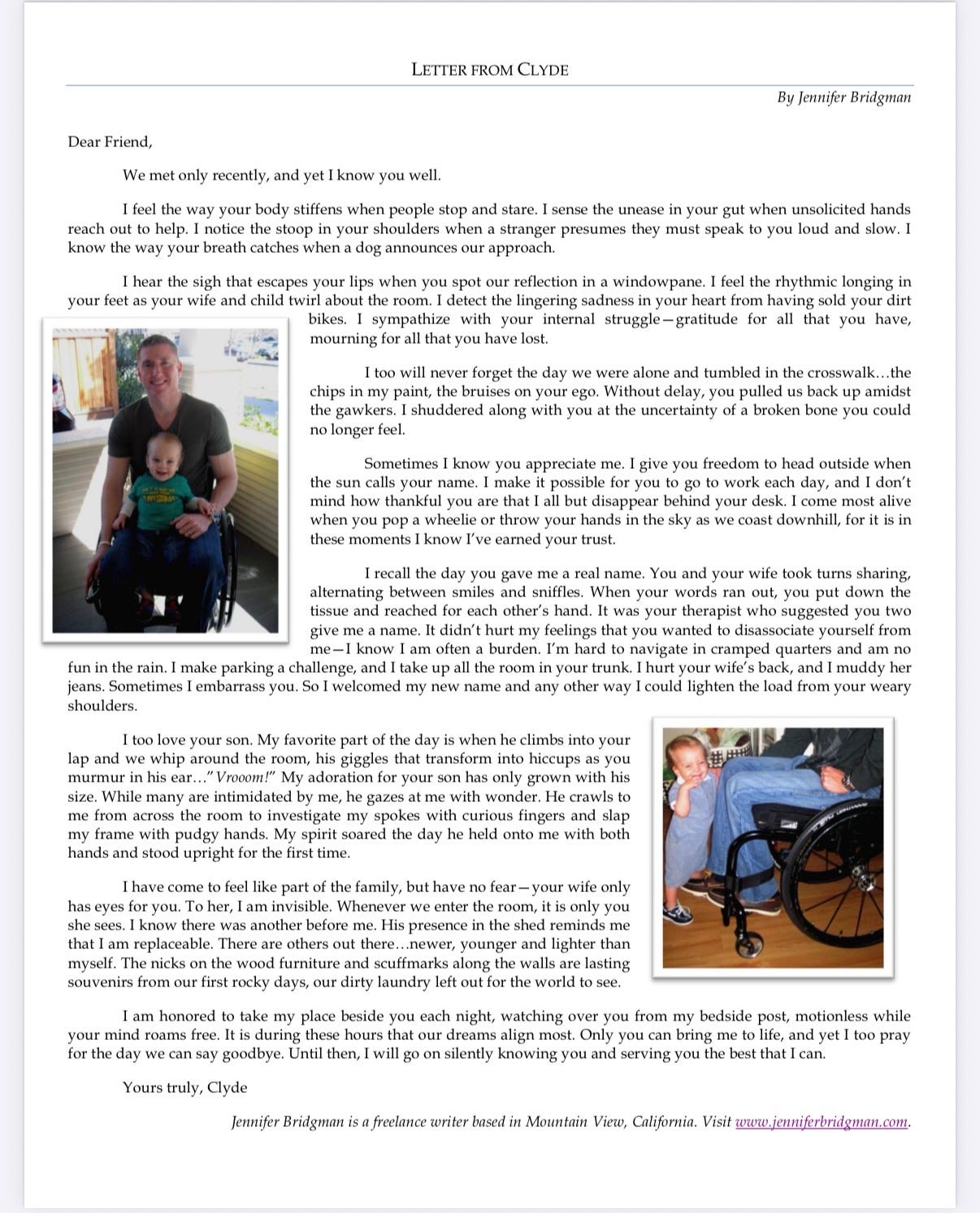
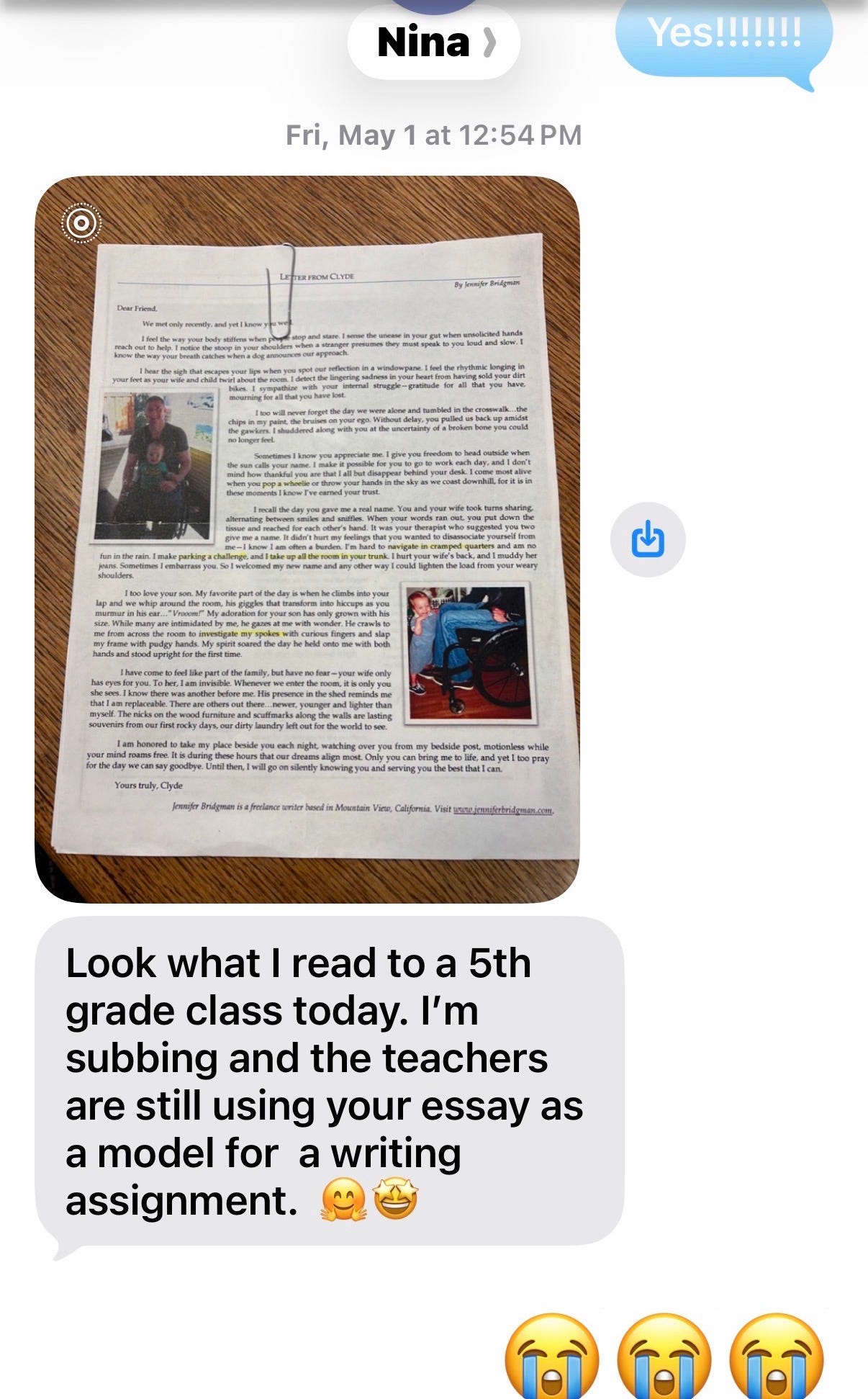
Jenny, you are such a talented writer. As I told you, every year your writing inspires 120 5th graders to write about their journey in elementary school from an inanimate object's perspective, just as the wheelchair is the narrator. Your beautiful writing is the perfect mentor text! Love, Nina.

Song to accompany When Scars Count Us In, dedicated to the teachers and students of this world—which means every one of us.
Walls by Kings of Leon.
If my words landed with you in any way, please tap the little heart, comment, restack, or subscribe. The connections built here mean so very much to me. xo, Jenny.
Damn, this is so beautiful. 💜
All that is here touched my heart so deeply. Thank you 🙏 Preparing to write from my moonstone necklace’s perspective 🌕